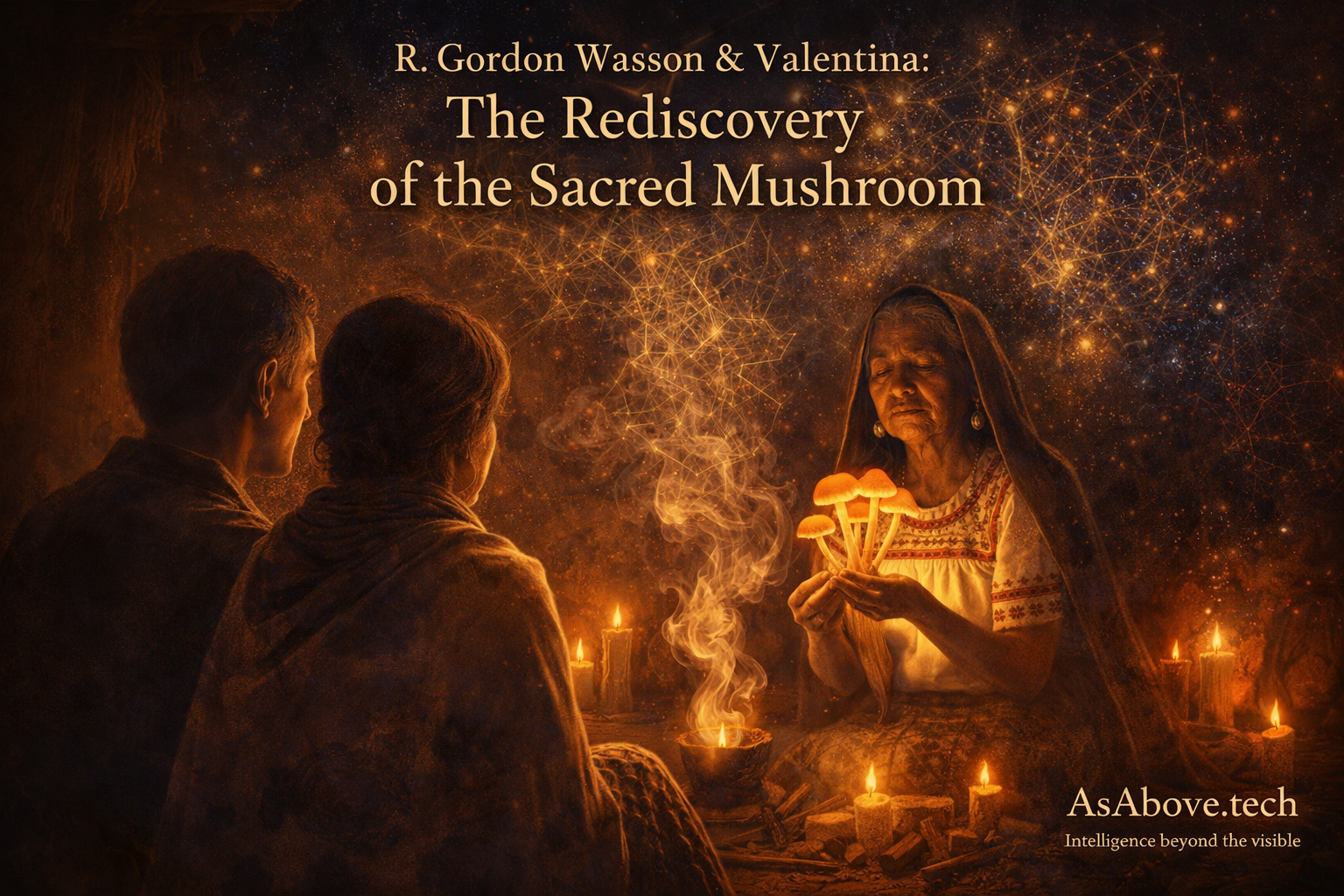
Then Valentina saw the mushrooms.
She darted off the path, her eyes lit with recognition. There, at the base of a tree, grew a cluster of wild mushrooms. To Valentina, they were old friends — the same species she had known in her native Russia, gathered by her mother and grandmother, cooked in soups and sauces, celebrated in folk songs and fairy tales.
To Gordon, they were poison. Toadstools. Things you never touch, let alone eat. He watched in horror as his new bride knelt in the forest duff, gathering these clearly deadly organisms with evident delight.
"Tina," he said, using his pet name for her, "what are you doing? Those will kill you."
She laughed at him. Laughed! And that night, she cooked the mushrooms and ate them in front of him, while he refused to touch them, certain he was about to become a widower.
She didn't die. She was fine. Better than fine — she was amused by his fear, and puzzled by it. In Russia, everyone knew mushrooms. Children learned to identify them as naturally as they learned to read. How could her husband — an intelligent, educated man — be so ignorant of something so fundamental?
And how could she — this sophisticated, scientifically trained physician — be so casual about something so obviously dangerous?
That night, lying in their cabin, they talked. Why was he so afraid? Why was she so unafraid? It couldn't just be personal temperament — something deeper was at work. Something cultural. Something that divided not just the two of them, but entire civilizations.
They had stumbled onto a mystery. And they would spend the rest of their lives together unraveling it.
I. Mycophilia and Mycophobia
The Wassons had discovered something remarkable: the world was divided into peoples who loved mushrooms and peoples who feared them. They coined terms for these attitudes — mycophilia (mushroom-loving) and mycophobia (mushroom-fearing) — and began to map which cultures fell into which category.
The mycophilic peoples included Russians, Poles, Catalans, Southern Italians, Japanese, and Chinese. These cultures had rich vocabularies for mushrooms, extensive culinary traditions, and deep folk knowledge about which species were edible, which were medicinal, and which were dangerous.
The mycophobes included the Anglo-Saxons — the English, Americans, and their cultural descendants. For them, mushrooms were all "toadstools" (a word whose etymological connection to witchcraft the Wassons found significant), all presumed poisonous until proven otherwise, all vaguely associated with death, decay, and dark magic.
Why did this division exist? What ancient divergence had caused some cultures to embrace mushrooms while others feared them? The Wassons began reading everything they could find — ethnographic accounts, folklore collections, historical documents, botanical studies. Gordon brought his journalist's instinct for research; Tina brought her medical training and her insider knowledge of Russian mycophilia.
What started as a marital curiosity became an obsession. Every vacation became a research expedition. Every dinner party became a data-gathering opportunity. Their apartment filled with books, notes, correspondence with scholars around the world.
II. The Lives Before the Quest
Valentina Pavlovna Guercken (1901-1958)
Valentina was born in Moscow in 1901 to a prosperous family. Her childhood was shaped by the rhythms of Russian life — including the late summer ritual of mushroom gathering, when entire families would venture into the forests with baskets, returning with the ingredients for soups, pickles, and dried stores for winter.
The Revolution disrupted everything. Valentina fled Russia as a young woman, eventually making her way to London, where she enrolled in medical school. It was there, sometime around 1921, that she met Gordon — a young American abroad, with a quick mind and an interest in everything.
She completed her medical degree in 1927, specializing in pediatrics. Brilliant, beautiful, and linguistically gifted — she spoke Russian, English, French, and eventually Spanish — Valentina brought a scientific rigor to their amateur investigations that transformed them from hobby into genuine research.
R. Gordon Wasson (1898-1986)
Robert Gordon Wasson was born in Great Falls, Montana, the son of an Episcopalian minister. His early career was in journalism — he wrote for the New Haven Register and later the New York Herald Tribune. But his true talents lay in finance and research, and in 1934 he joined J.P. Morgan & Co., eventually becoming a vice president.
By day, he was a Wall Street banker — proper, precise, respectable. By nights and weekends, he was increasingly consumed by the mystery of mushrooms. His position at Morgan gave him the resources to fund their research — and the connections to meet the scholars and scientists they needed.
The combination was unusual: a conservative banker and his Russian physician wife, spending their spare time investigating why some cultures fear fungi. Their friends thought they were eccentric. They didn't know the half of it.
III. The Years of Research
For three decades, the Wassons pursued their investigation. They traveled widely — to Russia, Catalonia, Japan — anywhere mushroom culture was strong. They corresponded with ethnographers, folklorists, linguists, and botanists. They accumulated a library of sources and a network of collaborators.
Together with their Russian cook Florence James, they began compiling a cookbook of mushroom recipes. But the project kept expanding. The cookbook became a cultural history. The cultural history became something larger — an investigation into the role of mushrooms in human civilization, religion, and consciousness.
In the early 1950s, their research took a dramatic turn. They encountered references to something that went beyond culinary culture — reports of mushrooms used not for food but for visions. Indigenous peoples of Mexico, they learned, had preserved ceremonies involving sacred mushrooms that could transport the consumer to other realms of consciousness.
The Spanish conquistadors had documented the Aztec use of teonanácatl — "flesh of the gods" — in the sixteenth century. The Catholic Church had suppressed these practices as diabolical. But had they truly disappeared? Or had they survived, hidden in remote mountain villages, waiting to be rediscovered?
IV. The First European Record
Before we follow the Wassons to Mexico, we must understand what they were seeking — and what had been lost.
The earliest European records of Mexican mushroom use come from the Spanish friars who accompanied the conquistadors. Fray Bernardino de Sahagún, in his monumental Historia General de las Cosas de Nueva España (compiled 1545-1590), provided detailed descriptions:
Similar accounts appear in the works of other chroniclers — Toribio de Benavente (known as Motolinía), Diego Durán, and others. They described mushrooms consumed at royal coronations, religious festivals, and healing ceremonies. The Aztec nobles considered them sacred sacraments, bridges to the divine realm.
But the Spanish saw only devil worship. The Inquisition prosecuted indigenous people who continued the ceremonies. The practices were driven underground, far from European eyes. By the nineteenth century, most scholars assumed they had died out entirely.
Pre-Columbian Antiquity
Yet the archaeological record told a different story. Scattered across Guatemala and southern Mexico were hundreds of stone sculptures known as "mushroom stones" — carved figures depicting human or divine beings merged with mushroom forms. The oldest dated to 1000 BCE or earlier.
The Mayan codices contained references to mushroom rituals. The Aztecs had elaborate mythology surrounding teonanácatl, linking it to Quetzalcoatl and other deities. This was not some marginal folk practice — it was central to the religious life of Mesoamerica's greatest civilizations.
And it stretched back far further than the historical record. In the Tassili n'Ajjer of Algeria, rock paintings dating to 7,000-9,000 BCE appeared to depict mushroom-shaped figures — possible evidence that the relationship between humans and psychedelic fungi extended to the dawn of human civilization itself.
V. The Journey to Huautla
In 1953, Gordon Wasson made his first expedition to Mexico, traveling to the remote Mazatec highlands of Oaxaca. He went without Valentina — her health had begun to decline, and the journey was arduous. But she was with him in spirit, as she had been in every stage of their research.
The trip was inconclusive. Wasson found evidence that the ceremonies still existed, but he could not participate. The Mazatec people were understandably cautious about sharing sacred practices with outsiders — especially foreign ones asking too many questions.
He returned in 1954 and again in 1955, each time getting closer. He learned some Spanish and Mazatec. He made friends in the villages. He approached not as a curiosity-seeker but as a genuine seeker of understanding. And finally, in the summer of 1955, he was granted admission to the inner sanctum.
June 29-30, 1955
"Eat them," she said. "They will show you what you need to see."
What followed was one of the most significant nights in the history of Western consciousness. Wasson consumed the mushrooms and experienced, for the first time, what the Aztecs had called communion with the divine.
He later described the experience in language that struggled to convey what he had witnessed:
He understood, in that night, what their thirty years of research had been leading toward. The mystery of mycophilia and mycophobia was not merely culinary or cultural. It pointed to something deeper — the role of mushrooms as a vehicle for transcendent experience, a technology for accessing dimensions of consciousness that modern civilization had forgotten or repressed.
VI. María Sabina: The Curandera
María Sabina deserves her own place in this story. Born around 1894 in Huautla de Jiménez, she had been conducting mushroom ceremonies — called veladas — since childhood. She was a sabia (wise one), a healer who used the sacred mushrooms to diagnose illness, find lost objects, communicate with the dead, and guide souls through spiritual crises.
For her, the mushrooms were not drugs to be studied but holy beings to be approached with reverence. She called them nti-si-tho — "that which springs forth" — or los santos niños — "the holy children." In her veladas, she would sing all night, her chants guiding the participants through visions, asking the mushrooms to reveal what needed to be known.
She took a great risk in admitting Wasson to a ceremony. The veladas were sacred, private, protected. To share them with outsiders was to expose them to misunderstanding and exploitation. But something about Wasson convinced her that his intentions were genuine.
She would later have reason to regret that decision.
VII. The Life Magazine Article
On May 13, 1957, Life magazine — then the most widely read periodical in America — published a seventeen-page article by R. Gordon Wasson titled "Seeking the Magic Mushroom." It was illustrated with photographs by Allan Richardson and described, in vivid detail, the velada Wasson had attended.
The article was a sensation. It introduced the term "magic mushrooms" to the English language (though Wasson himself later regretted the phrase, feeling it trivialized the sacred). It brought the existence of psychedelic mushrooms to the attention of millions of Americans. And it sparked a wave of interest that would transform both Western culture and the remote village of Huautla.
The same year, the Wassons published their magnum opus: Mushrooms, Russia and History. Printed in a limited edition of 512 copies, it was a lavish two-volume work combining their decades of research on mushroom culture with Gordon's account of the Mexican discoveries. It remains a landmark in ethnomycology.
VIII. The Consequences
For Valentina
Valentina Pavlovna Wasson did not live to see the full impact of their work. Her health had been declining for years, and on December 31, 1958, she died of cancer at the age of fifty-seven.
She never made it to Mexico. She never experienced the velada herself. But without her — without that afternoon in the Catskills, without her mycophilia challenging Gordon's mycophobia, without her scientific training and linguistic gifts — none of it would have happened.
Gordon dedicated the rest of his life to their shared work. He continued to publish, to research, to collaborate with scientists and scholars. He proposed the controversial hypothesis that the ancient Vedic sacrament soma was actually the fly agaric mushroom (Amanita muscaria). He explored mushroom symbolism in Greek mythology and early Christianity.
But he never stopped mourning Tina. Every book, every article, every discovery was incomplete without her to share it with.
For María Sabina
The Life article brought unwanted attention to Huautla. Seekers — some genuine, many not — flooded into the village looking for the "magic mushrooms." María Sabina became famous, but fame brought her only trouble.
The Mexican authorities, embarrassed by the publicity, harassed her. Her neighbors blamed her for the invasion of foreigners. Her house was burned down — twice. She spent her final years in poverty, regretting that she had ever shared the sacred ceremonies with outsiders.
"Before Wasson, nobody took the little children simply to find God," she said. "They were always taken to cure the sick." The sacred mushrooms had become a commodity, divorced from the ceremonial context that gave them meaning.
For the World
The discovery of psilocybin mushrooms set in motion a chain of events that continues to this day. Albert Hofmann — the Swiss chemist who had synthesized LSD — isolated and identified psilocybin in 1958, working with samples Gordon Wasson had sent him. Timothy Leary read the Life article and traveled to Mexico, setting him on the path that would make him the high priest of the psychedelic movement.
The substances were criminalized in 1970. Research stopped. The veladas continued in secret. And the conversation that Valentina and Gordon started on their honeymoon — about why some cultures embrace mushrooms while others fear them — remained unfinished.
Only now, seventy years later, is science returning to the questions the Wassons raised. The clinical trials at Johns Hopkins and Imperial College are, in a sense, a continuation of the research that began in the Catskills in 1927.
IX. The Legacy of the Wassons
The Wassons invented a field — ethnomycology, the study of the role of mushrooms in human culture. They demonstrated that the human relationship with fungi was deeper, stranger, and more consequential than anyone had imagined.
But perhaps their greatest contribution was simply paying attention. They noticed something that others had overlooked — a difference in attitude between cultures, a puzzle hidden in plain sight. And they followed that thread for thirty years, through libraries and laboratories and remote mountain villages, until it led them to one of the great secrets of human consciousness.
It started with a marriage. A Russian woman and an American man, different in so many ways, found in their differences a mystery worth pursuing. The mycophile and the mycophobe, lying in their honeymoon cabin, asking each other: Why do we see this so differently?
That question — asked in love, pursued with rigor, followed wherever it led — changed the world.
X. Coda: The Terms They Coined
The Wassons gave us more than discoveries. They gave us a vocabulary for talking about our relationship with mushrooms:
- Mycophilia: Cultural love of mushrooms
- Mycophobia: Cultural fear of mushrooms
- Ethnomycology: The study of mushrooms in human culture
They showed us that our attitudes toward nature are not natural — they are cultural inheritances, shaped by history, passed down through generations, often invisible to those who hold them. Gordon's fear of mushrooms was not based on evidence or experience. It was ancestral, inherited from the Anglo-Saxon tradition that saw fungi as allied with darkness and death.
Valentina's love of mushrooms was equally inherited — from the Russian tradition that saw them as gifts of the forest, to be gathered with joy and eaten with gratitude.
Neither was more "natural" than the other. Both were human. And their marriage — their willingness to take each other's perspectives seriously — created something neither could have achieved alone.
Perhaps that is the deepest lesson of the Wasson story. Not just that mushrooms can open doors to other dimensions of consciousness. But that love can open doors to other dimensions of understanding. That when we take our differences seriously — when we ask "Why do you see this so differently?" — we may discover mysteries that transform everything.
Gordon Wasson died in 1986, at eighty-eight years old. He had continued writing and researching until near the end. On his deathbed, he is said to have been at peace — ready, perhaps, to join Tina in whatever realm she had been waiting for him.
They are buried together. The mycophile and the mycophobe. The banker and the doctor. The seekers who asked a question on their honeymoon and spent their lives pursuing the answer.
The quest continues.