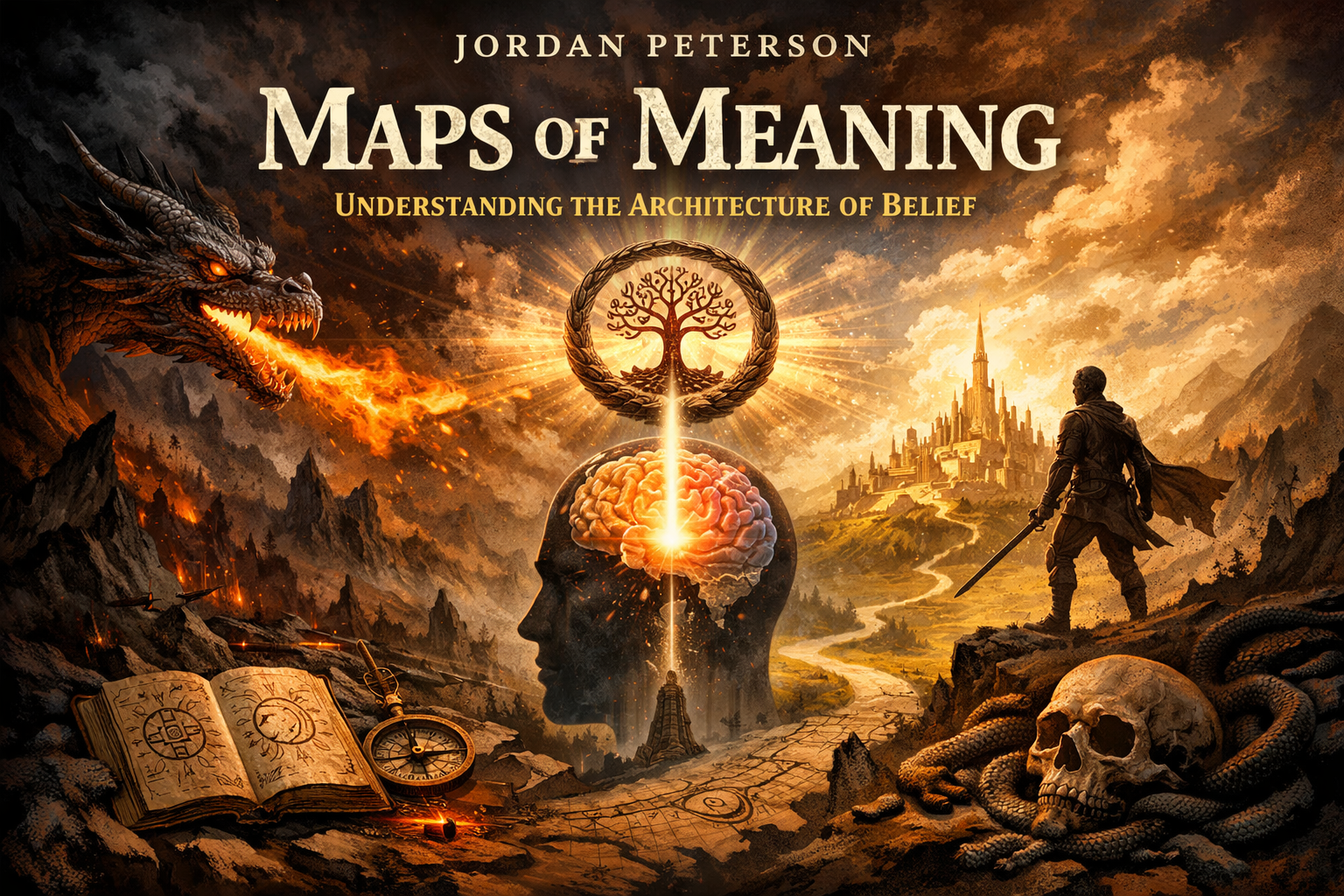
The Essential Question
Why do people believe what they believe? Not the surface-level justifications we give to others, but the deep architecture that makes certain beliefs feel true, important, worth dying for. This is the question that drove Jordan Peterson to write Maps of Meaning — a 15-year project that synthesizes mythology, psychology, neuroscience, and philosophy into a unified theory of how humans construct meaning.
Peterson's obsession began during the Cold War, watching both capitalist and communist systems produce atrocities while their adherents remained utterly convinced of their righteousness. How could intelligent people believe things that led to gulags? To genocide? To willing self-destruction?
The answer, Peterson discovered, lies not in what people consciously think, but in the unconscious structures that organize perception before rational thought even begins. These structures — encoded in mythology, religion, and story — are the "maps of meaning" that tell us what matters, what to approach, what to avoid, and who we should become.
"The purpose of life is finding the largest burden that you can bear and bearing it."
The Core Framework
Peterson builds his theory on a single, powerful observation: the world presents itself to us as a place of action, not a place of objects. Before we see "a chair," we see "something to sit on." Before we see "a snake," we see "danger!" Our perception is inherently value-laden, structured by our goals, fears, and evolutionary history.
The Fundamental Domains of Experience
🌌 Chaos
The unknown, the unexpected, the source of all threat and all possibility. In mythology: the dragon, the abyss, the Great Mother, the unconscious. The domain we enter when our plans fail.
🏛️ Order
The known, the expected, territory mapped by culture and habit. In mythology: the wise king, the father, the walled city. The domain of security, competence, and sometimes tyranny.
🗡️ The Individual
The heroic consciousness that mediates between chaos and order. The figure who voluntarily confronts the unknown, extracts new information, and updates the culture.
This tripartite structure — Chaos, Order, and the Mediating Individual — appears across every mythology Peterson examines. The Egyptians had it (Osiris, Seth, Horus). The Mesopotamians had it (Tiamat, Marduk). Christianity has it (Hell, Heaven, Christ). It's not cultural coincidence — it's the deep structure of how conscious beings must relate to reality.
The Neuropsychology of Meaning
What makes Maps of Meaning more than philosophical speculation is Peterson's integration of neuroscience. The brain, he argues, literally perceives the world in terms of these archetypal categories because that's how evolution shaped it.
The Two Systems of Perception
Goal-Directed System
When pursuing a goal, the brain categorizes everything as either "helps achieve goal" (positive emotion) or "obstructs goal" (negative emotion). This is the domain of ORDER — known territory where predictions work.
Threat-Detection System
When something unexpected happens, a different system activates — one that generates anxiety, freezes behavior, and demands explanation. This is the encounter with CHAOS. The unknown has intruded.
Exploratory System
The heroic function — the capacity to voluntarily enter the unknown, map it, and transform chaos into usable order. This is what separates adaptive organisms from those who hide from novelty.
Why Mythology Matters
If our brains are wired to perceive the world through these archetypal lenses, then mythology is not primitive superstition — it's concentrated wisdom about how to navigate existence, encoded in stories that bypass the rational mind and speak directly to the perceptual systems.
The hero myth, for instance, isn't just entertainment. It's a behavioral template: here is how you confront the dragon. Here is what happens if you don't. Here is the transformation that awaits if you succeed. Thousands of generations tested these patterns against reality. The stories that survived contain hard-won knowledge about what works.
"Myths are not falsehoods. They are the psychological equivalent of the body's immune system. They encode the wisdom of the species in a form that can be quickly absorbed and acted upon."
The Monomyth Structure
Peterson traces Joseph Campbell's "hero's journey" through neuropsychological analysis:
- The Call to Adventure: Something anomalous intrudes. The known world reveals its insufficiency. Chaos beckons.
- Crossing the Threshold: The hero voluntarily leaves the domain of order. This is the critical act — choosing to explore rather than hide.
- The Ordeal: In the belly of the whale, confronting the dragon. The worst fears manifest. The hero must die to their former self.
- The Reward: Something valuable is extracted from chaos — gold, a princess, a boon. New information that will benefit the community.
- The Return: The hero brings the treasure back and integrates it into the culture, updating the collective map of meaning.
The Shadow and the Dragon
Peterson draws heavily on Jung's concept of the shadow — the parts of ourselves we refuse to acknowledge. The dragon in mythology often represents this shadow: the capacity for malevolence that we pretend doesn't exist.
The critical insight: You cannot be truly good until you are capable of being evil and choose not to be. The hero who has never confronted their own darkness is not virtuous — they're merely harmless. True virtue requires the integration of the shadow.
🐉 The Dragon of Chaos
The externalized unknown — what lurks in the forest, in the depths, in other people. The source of threat, but also the guardian of treasure.
👤 The Internal Dragon
The shadow — your own capacity for cruelty, resentment, and destruction. Confronting this is even harder than confronting external threats.
The Implications for Modern Life
Peterson's framework isn't academic — it's immediately practical. If meaning comes from the voluntary confrontation of chaos in service of higher order, then:
- Avoidance creates pathology. Every dragon you refuse to confront grows larger. Anxiety disorders, depression, and resentment often stem from accumulated avoidance.
- Responsibility is the antidote to meaninglessness. Taking on burdens — choosing them voluntarily — is how you construct meaning. The bigger the burden you can bear, the more meaningful your life.
- Truth-telling is heroic. The act of articulating reality clearly, even when it's painful, is a form of dragon-slaying. Lies are the linguistic equivalent of hiding from chaos.
- Sacrifice is necessary. You must give up something of value now for something of greater value later. This is the deep logic of civilization itself.
💡 Implementation Guide
Maps of Meaning is dense and difficult. Here's how to extract actionable value:
Week 1-2
Read the Introduction and Chapter 1 only. Don't rush. Absorb the fundamental framework of chaos/order/hero. Journal on where you see these patterns in your own life.
Week 3-4
Identify your dragons. What are you avoiding? What conversations won't you have? What competencies refuse to develop? Write them down.
Week 5-8
Voluntary confrontation practice. Pick ONE small dragon and face it deliberately. Notice the anxiety. Do it anyway. Document the transformation.
Ongoing
Use the chaos/order lens to analyze decisions. Is this action expanding your domain of order? Or are you hiding? The framework becomes a decision-making tool.
Criticisms and Limitations
The book is not without flaws. Peterson's prose can be dense to the point of impenetrability. The neuropsychological claims, while interesting, sometimes outrun the evidence. And the Jungian framework, while productive, is not universally accepted in academic psychology.
More substantively: Peterson's emphasis on the individual hero can underweight systemic factors. Not every problem is a dragon to be slain by personal courage. Some require collective action, institutional change, or simple good luck.
Still, as a framework for understanding why meaning matters, how belief systems form, and what constitutes psychological health, Maps of Meaning remains one of the most ambitious syntheses of the past century.
Who Should Read This
- Those wrestling with meaninglessness. The book provides a framework for understanding why life feels empty and what to do about it.
- Students of mythology and religion. Peterson reads ancient texts with fresh eyes, revealing structures that persist across cultures.
- Therapists and coaches. The chaos/order framework provides powerful diagnostic and intervention tools.
- Anyone interested in the deep structure of belief. Why do ideologies possess people? Why do some ideas feel sacred? This book answers.
"You can only find out what you actually believe (rather than what you think you believe) by watching how you act. You simply don't know what you believe before that. You are too complex to understand yourself."
The Bottom Line
Maps of Meaning is not a book you read — it's a book you work through. It demands attention, re-reading, and active engagement. But for those willing to put in the effort, it offers something rare: a coherent framework for understanding why anything matters at all.
In an age of nihilism and ideological possession, that might be the most valuable thing a book can provide.